
The Unholy Presence
Redemption is elusive, and the arc it travels in a fully lived lifespan is often hard to trace and understand.

A younger, hairier and certainly dumber version of me was an early Led Zeppelin fan, for a fairly short time. I was fifteen; it was 1970. I saw the band twice over the next couple of years. No big lights, no screens or effects, just huge amplifiers and PA stacks belting out hard rock. Zeppelin were like a force of nature: wild, noisy, slightly unhinged, playing that sweet song of youth just for me, whether through a bedroom record player or inside medium-sized, ramshackle venues in Central Scotland.
The first four records (as they were then) were solid gold, classic rock statements, clever, brainstorming performances captured with astonishing production techniques. Any hint of plagiarism had yet to be called out, though I knew enough about the blues’ back catalogue to recognise the links and hear the influences. When my tastes eventually moved on, my liking for their later music slowly began to unravel along with my own listening experiences. Houses of the Holy and Presence signalled bits of unexpected weakness. A wobble had set in.
Looking back, those two albums coincided with me growing up and listening to other types of music. I wanted more of the magic, but suddenly they hit that soggy middle phase so many rock bands reach, and something changed. I’d lost something. Those records really bugged me. They signalled the end of something in me and in the music that I followed. These were harder listens, distancing me from what had once been solid youthful loyalty. Your heroes will let you down. They stand on the same clay feet we all do.
Houses and Presence carried within them the seeds of what all fans dread: the big let-down. Some might call it betrayal. The message that says, we’re not really trying, we’re tired, we’ve a contract to fulfill, so we’ll just put out what we can and take your money. The power and cynicism of the music business in action. But it’s not quite that simple. I won’t forget the highs, the ones most of my generation shared and understood. There really was an electric magic for a while, something that lit up our lives. We owned a tiny part of it. That’s gone now, and I’ll be mostly negative in listing my observations and gripes about the slump and the lows that followed.
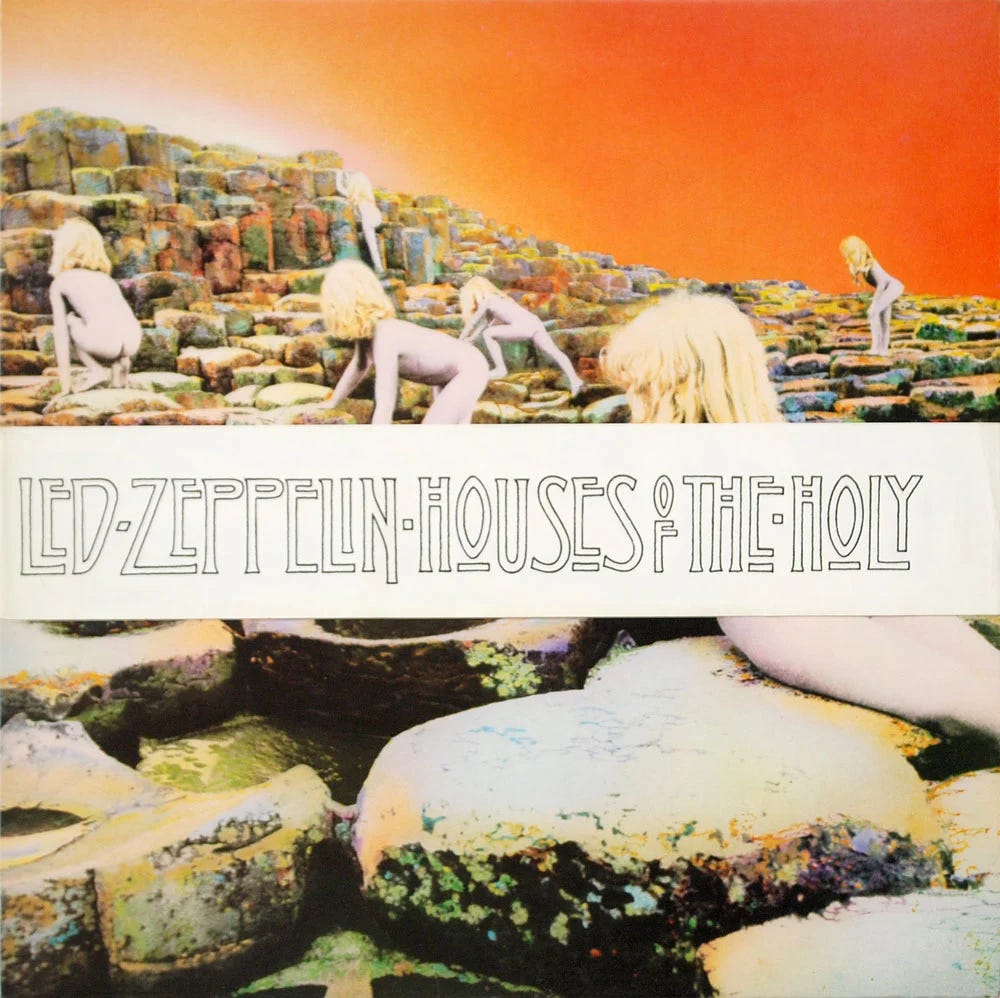
Houses of the Holy (1973)
Inconsistent tone. This album doesn’t quite hold together. It feels more like a collection of experiments than a coherent band statement. You can almost hear them asking, “What kind of music should we be making now?” It’s plainly less cohesive than the earlier albums. Many tracks feel like sketches rather than fully developed songs, though the experimentation does pay off on “No Quarter” and “The Rain Song.” It’s ambitious but transitional. Maybe it had to be that way for Physical Graffiti to follow on and land with greater and more diverse impact. There was hope and energy shown in PG despite some material coming from recording sessions shared with Houses. Someone’s judgement may have failed there. Fatigue, flatness and a lack of inspiration just happen if you’re too close to the process.
Novelty ideas that failed. “The Crunge” and “D’yer Mak’er” are major mistakes that haven’t aged well. Some find them fun; I never did. They sound like a band bored with itself, dabbling in bad ideas without fully committing. Perhaps the writing and recording process had become too insular, with no external voices offering perspective. Maybe they were too bruised by earlier career criticism to seek outside input.
Whatever was wrong with the recipe, I knew from day one that this was the first Zeppelin album I couldn’t listen to straight through without skipping tracks. That was a new and unsettling feeling. There are flashes of wonderful playing and composition buried within; the four musicians were simply too good not to generate moments of brilliance, but overall, for me it felt like a struggle to listen to it as a whole.
The overly weird cover. It looked strange then and still does. I remember the band (or some some media person) blaming delays in the sleeve artwork for the long gap between this album and it’s predecessor IV, which only raised expectations further. The result is cold, disturbing, and oddly uninviting, art for art’s sake. If you came expecting the thunder and lightning Zeppelin, the sleeve already warns you otherwise. This is a more complicated, esoteric place, and not a particularly welcoming one.
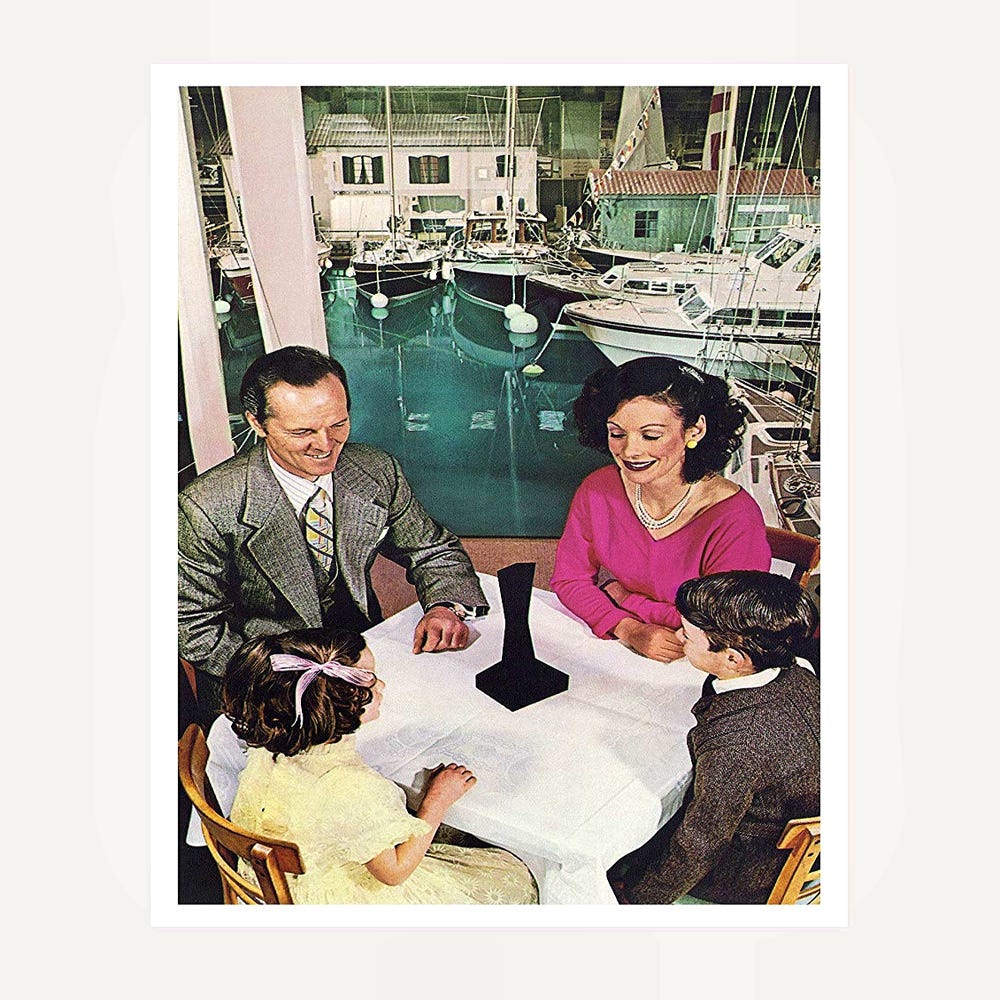
Presence (1976)
Relentless, narrow, one-dimensional. The flip side of the album’s bombastic energy is its fixation on monotony. Much of it sits in the same mid-tempo, minor key grind, moving forward “for no good reason”, the motivation that killed most 70s progressive rock. Guitar riff driven and tense, but lacking light and shade, it often chases its own tail. “Achilles Last Stand” and “Nobody’s Fault but Mine” tower over the rest, while the remaining tracks feel like a jumble of weaker ideas. This is Zeppelin in survival mode: a band sick of itself. I hear impressive rock stamina but it’s all bogged down by limited emotional range and imagination.
Below-par vocals and lyrics. Robert Plant was still recovering from his accident and other personal troubles, and it shows. Less range, less passion, fewer things to say. The sessions should probably have been postponed and a break taken, but bands either keep moving or die and the punk revolution was just around the corner. The “dinosaur” tag now beginning to stick. The guitar tone has lost it’s edge. Where was that Telecaster bite?
Forgettable songs. Tracks like “Candy Store Rock” and “Hots On for Nowhere” feel underwritten by Zeppelin’s own standards, simply uninspired.
The cover art. Conceptually clever, and with hindsight arguably ahead of its time, especially now, fifty years on, as we sink into a sea of mobile devices. But it didn’t draw you in at all. Mostly, it confused an audience that, however restless, just couldn’t grasp it.
So where are we now? It’s all ancient history. I can’t remember the last time I listened to their music or sat staring at one of their album covers. That piece of the past is behind a door I find hard to open, but for a while it burned as brightly as any music ever has in my life, and I’m grateful for that. I’m also saddened that it ended with John Bonham’s death, and that the remaining members had to find other routes back into music; some managing that better than others. I couldn’t follow their later careers the way I had done the first time around. Time just slipped away. Redemption can be elusive for us, and the arc it travels in a fully lived lifespan is often hard to trace and understand.