
Misunderstood from a Distance
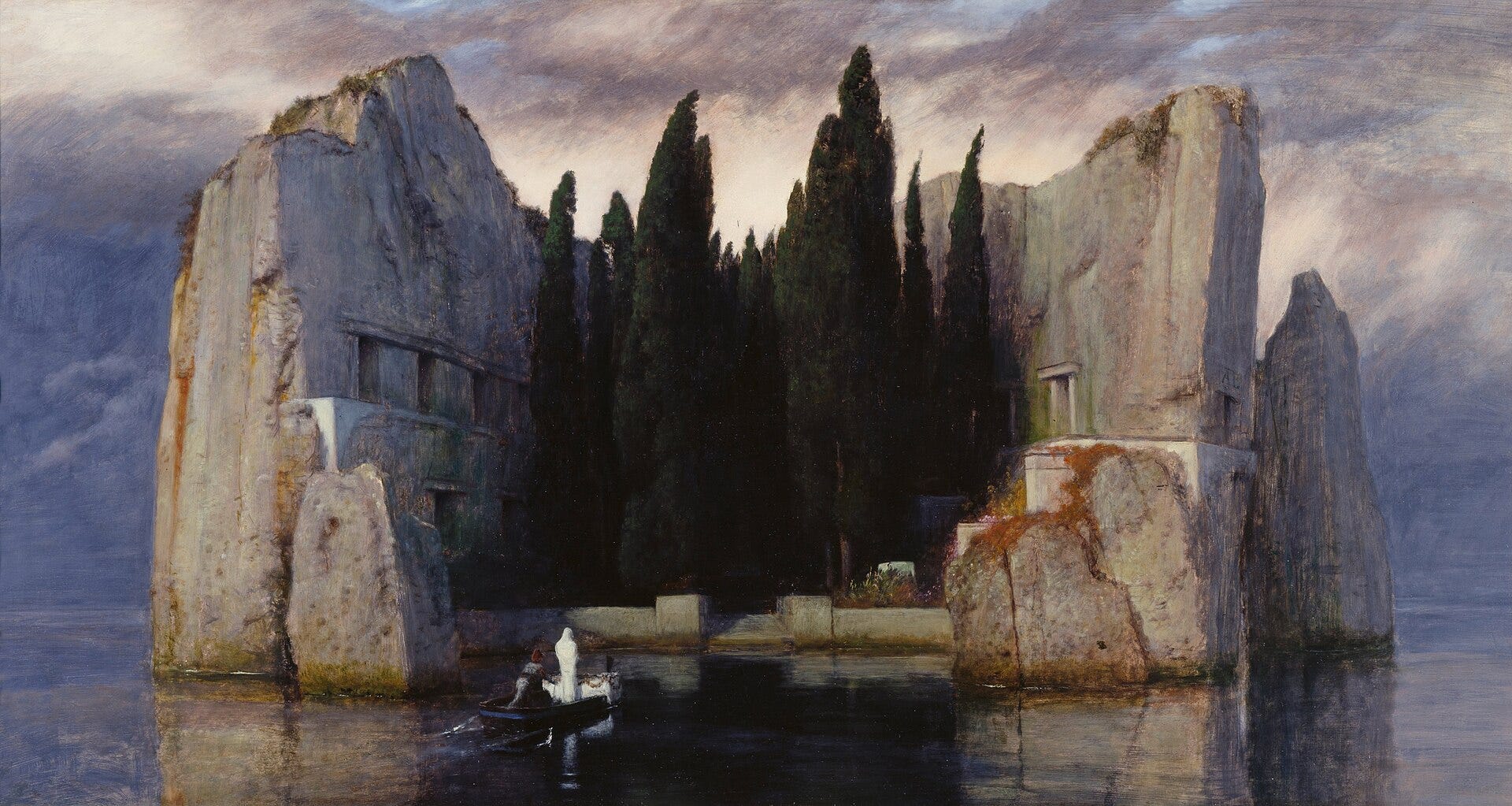
The Isle of the Dead. Painted in five versions by Arnold Böcklin between 1880 and 1886.

Doctor Foster disliked microphones.
They flattened out the voice, or so he felt. They removed it’s humanity. It’s quirks. But the lecture hall at St. Andrews was newly renovated and dedicated; all the great and the good had been mentioned and thanked. It was a busy, almost “pop-up” lecture program, and he had the honor of being the first speaker. The podium light glowed red; recording had begun.
Behind him, projected ten feet tall onto the screen, hung the dark silhouette of cypress trees and a pale boat gliding toward stone structures.
“The Isle of the Dead,” he began, gesturing toward the image. “Many of you will be aware that a copy hangs in my class room. Painted in five versions by Arnold Böcklin between 1880 and 1886. It is not a depiction of death as horror, but as inevitability. As stillness. As arrival. Tranquility in the moment.”
Near the back of the hall, a student slipped out to take a call.
Foster continued. “What makes the work enduring is not morbidity. It is intimacy. Böcklin gives us something unsettling because he refuses to grandstand. He gives us quiet water. Bare stone. Mature cypress trees. And that single white figure. We are not shown grief. We are shown acceptance.”
He paused, looked up at the shrouded shape in the boat.
“Somehow, because of that,” he said, “I love the dead in this painting.”
The microphone crackled, as microphones sometimes do. A bad connection, perhaps.
In the corridor, the theatre door swung halfway shut and swallowed the first half of the sentence. The student heard only:
“…love the dead…”
He hesitated, a puzzled look on his face.
Inside, Foster went on. “Not as corpses, of course, but as presences rendered without melodrama or theatrical emotion.”
The rest was lost in the closing latch.
Dr. Foster spoke for another ten minutes or so about Böcklin’s life and his now infamous fan club.
Various other speakers and subjects came and went as the evening moved on.
But by morning, the “sentence” had reinvented itself.
A second year art student told her roommate, “He said he loved the dead. Like, straight out, he said it.”
By afternoon, it was smoldering: “He has an unhealthy fascination with death.”
By evening, someone had clipped a six second fragment from the lecture recording, audio only, stripped of context. The waveform showed a gap before the words:
“…I love the dead…”
The clip began to circulate in a campus group chat.
Someone added a gravestone emoji.
Someone else added, “Explains all the cemetery photos on his Insta.”
Foster had posted those years ago, as reference material for a seminar on funeral art and sculpture design. They resurfaced now, but with new captions.
Beetlejuice and Frankenstein GIFs appeared in the chat.
Then the Alice Cooper song.
Nailed it.
There was that odd see-saw effect, between comic and horror. Crime possibly being the pivot point.
Serious and not so serious comments were added.
The other “n” word remained behind a curtain nobody wanted to tug.
The first email arrived at 8:13 a.m.
Please clarify your remarks.
Students feel unsafe.
Unsafe?
Foster reread the word several times. He drafted a reply explaining Böcklin’s symbolism, the long tradition of memento mori, the meditative function of the painting. It’s place in art history. He attached the full lecture recording.
The department chair responded curtly:
We would recommend refraining from provocative phrasing.
Provocative?
He listened to the clip himself. The microphone had cut slightly before “In that sense.” There was a faint pop. The words did sound different, stronger. Not what he had meant. At all.
“I love the dead.”
Strange, isolated.
Without muscle and formless, a sentence with no bones.
Two nights later, campus security called.
The groundskeeper had reported someone near the old cemetery, sometime after hours.
It was Dr. Foster.
He had walked there often, especially when thinking. The cemetery bordered the river; it was quiet. The stones tilted at almost jaunty angles. Names softened by lichen. Symbols. Dates. Shadows in the carvings and a lonely shelter of a kind.
He explained this calmly.
The campus security officer’s gaze lingered.
“Just doing research?” he asked.
“Yes.”
“For what?”
Foster hesitated, perhaps a fatal pause.
“For a lecture,” he said.
The officer nodded slowly, as if noting something down.
Enrollment in his seminar dropped by half.
A parent wrote to the principal.
A local news blog picked up the clip. The headline read:
LECTURER DECLARES LOVE FOR THE DEAD – STUDENTS CONCERNED
The article mentioned Böcklin briefly. It mentioned “macabre preoccupations” at greater length.
Someone spray painted a crude heart and a coffin on his office door.
Foster stopped correcting people.
Each correction seemed to deepen suspicion. Each explanation sounded defensive.
At the next faculty meeting, conversation evapourated when he sat down.
He became careful with language. Painfully careful.
He avoided words like “corpse,” “burial,” “mourning.” He replaced them with “absence,” “transition,” “memorial culture.”
The painting still hung in his classroom.
He began to wonder if it had always felt so dark.
Weeks later, another grave in the cemetery was found disturbed; soil shifted, flowers scattered.
Teenagers, most likely.
But when the police knocked on his door, they were polite in the way that comes before an accusation.
“We just need to ask,” one said.
Of course you do, Foster thought.
He could, reluctantly, see how the story fitted together from the outside:
The lecture.
The clip.
The cemetery walks.
The solitary man with a specialty in death.
A speculative narrative can be a kind of gravity. Once formed, everything falls toward it.
“I have never disturbed a grave,” he said evenly.
The officer nodded, noncommittal.
That night Foster replayed the full lecture again.
He watched himself gesture toward the projected island.
He heard the complete sentence, intact:
“In that sense, I love the dead in this painting.”
He paused the video.
The white figure in the boat seemed nearer than before. The dark trees rose like closed ranks.
He imagined speaking again, more clearly:
“The Isle of the Dead.”
He enunciated it aloud in his empty flat.
Isle.
I’ll.
I love.
The syllables pressed close together, now treacherous.
Language, he realized, is only stable when clear diction holds it in place.
Without clarity, it breaks.
He looked at the still frame, the silent boat approaching stone.
For the first time, he felt not his artistic admiration, but kinship.
Not with the dead.
With the island.
The island itself.
Isolated.
Surrounded.
Misunderstood from a distance.
And still very quiet.