
Disposable Cities
If you are of a certain age, you are irrelevant. Too old to adapt, too rooted to object effectively. Silence, after all, can be a mercy.

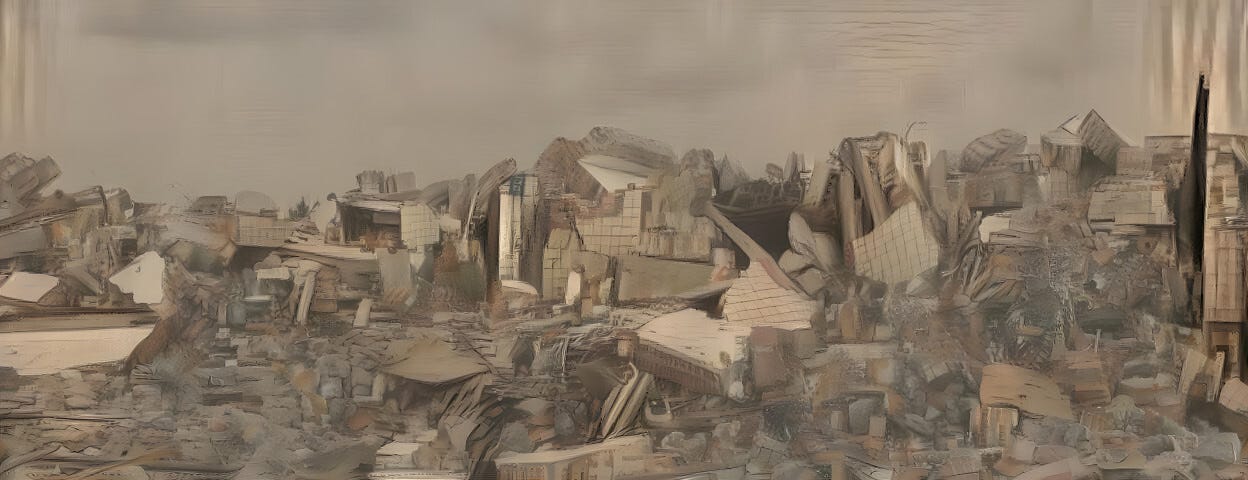
There exists, scattered and unannounced, a fraternity of minds who believe the planet has grown weary of us. They do not shout their intentions. They reason them. They sketch them on napkins, encode them in equations, disguise them as art. They are philosophers, engineers, scientists, misfits and dreamers; people convinced that humanity’s failure is not only moral but architectural. We were all built incorrectly. The system needs redesigning. A hard reset. They are the truest of environmental criminals.
They speak, half-playfully, of a second Genesis. Not the theatrical violence of flood or fire, but a patient creation: seven days elongated into seventy years. A slow correction. You may have passed one of them this morning. Perhaps they live on your street, sit across from you on a bus, breathe quietly behind you in a café. They are thinking not of destruction precisely, but of improvement. A strategy that slowly decides what must be removed so that something cleaner and superior may take its place. Is that terrible or sensible or both? Things cannot stay as they are.
If you are of a certain age, you are irrelevant. Too old to adapt, too rooted to object effectively. Silence, after all, can be a mercy. One is spared the discomfort of resistance, the bruising effort of change. When the time comes, the intervention will be clinical. Water supplies will be targeted, adjusted region by region; cities, towns, counties, states. A slow drip. No spectacle. Minimalist silence. No announcements. Silent enough to pass unnoticed until the impact. Short term chaos perhaps, as we disappear into shadows.
So we open the door to a unknown season of neglect. Pandora’s box in reverse. Decay allowed to proceed according to plan. In the great scheme of things it’s a few years of untidiness, collapse, death, all already accounted for. A tipping point into renewal. For the few a long withdrawal underground. Waiting in thousands of cocoons. Emergence. Wilding and a new and natural growth.
An invitation? Hardly. If you are reading this now, you have already missed the moment when choice was possible.
-----:-----
“It was dark. Your voice reached me as if through cloth, or perhaps through a hand pressed firmly over your mouth. I couldn’t tell. You called again, quietly, nervous and I flicked the torch on. Power was currency down here; we spent it sparingly. There were no days in the tunnels, no sunlight to divide time. Candles glowed faintly, stealing oxygen as they gave comfort. We had learned to accept the trade.
I followed your voice. Each brief click of the torch revealed your outline, perhaps a hundred yards ahead. I knew where you were going. You carried your keys. I carried mine, along with a few tools and a can of release oil in my pack. You had the rifle. I hoped for the ritual more than necessity, but reassuring all the same. I kept pace.
No one had been here for at least a year. The railway lines still lay in the tunnel, their dull metal catching and returning the torchlight in a faint, apologetic glow. No traffic. No disturbance. You reached the entrance. The pale geometry of daylight outlined itself at the edges. The first padlock resisted briefly, then yielded with a polite click. Mine followed suit. We drew the bolts together, top and bottom. The upper lever descended smoothly, releasing a small cloud of dust that hung motionless in the stale air.
The doors opened outward, an arguable design flaw. A rockfall, a fallen trunk, and we might have sealed ourselves in forever. We had debated that years ago and chosen speed and simplicity over absolute safety. Nothing, we had learned, is foolproof. The hinges complained softly as we pushed. Settlement and neglect. Then the light came flooding in.
It was extraordinary. We stood staring through the widening gap, unwilling to step forward. Sound travels. Attention follows sound. We had announced ourselves to whatever still occupied the surface.
We waited. Five minutes, perhaps more. No speech. No movement. A breeze touched our faces. Fresh air filled our lungs. I wanted to shout, to mark the moment, but restrained myself and simply tasted it. Despite everything we had done wrong for a thousand years, the air tasted superb right now, clean and cleaner than memory allowed. Perhaps it had worked. Perhaps those curious cells, dispersed across continents, patient and uncelebrated, had succeeded. The thought exhilarated me, though caution and a sense of loss returned quickly. This was no victory yet, only a threshold.
We watched through the narrow opening. The railway line curved away into an uncertain distance. Grass and weeds thrust up between the sleepers. Moss softened and coloured every surface. The embankments had surrendered completely: shrubs, young trees leaning eagerly into the light. There were insects. A few, but unmistakable. Bees, perhaps. Flies. Signs of negotiation, not conquest.
Then came the sharp crack of a footstep on a fallen branch.
We were not alone.”